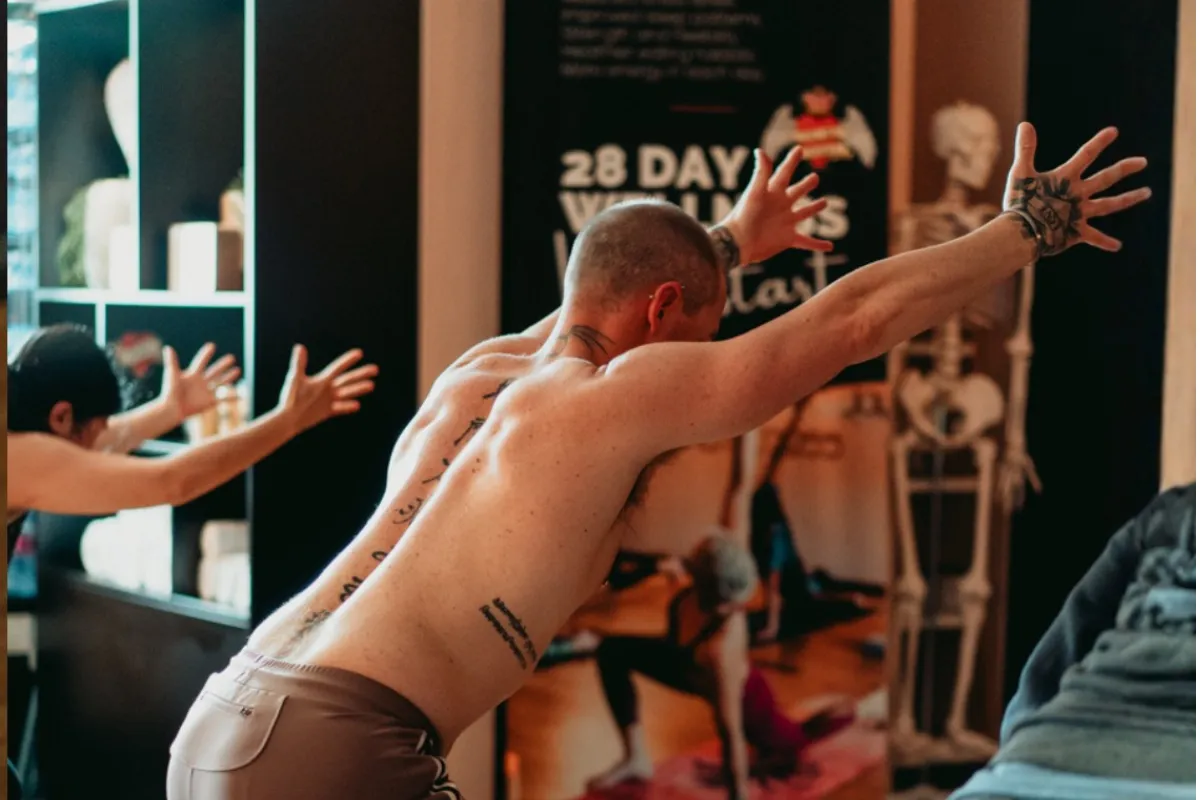
Chair Pose: Why It's Harder Than It Looks and How to Build Real Strength From It
Chair Pose gets no respect.
People drop into it, hold for a few seconds, come back up, and move on without much thought. It looks like a half-squat. It doesn't feel particularly special. And yet the same people who breeze through it are the ones wondering why their legs aren't getting stronger, why their lower back keeps aching, and why their yoga teacher keeps walking over to adjust them.
What those people are doing and what Chair Pose actually is are two completely different things.
Done properly, this is one of the most demanding standing poses in yoga. Quads under sustained load. Glutes firing to stabilise the pelvis. Deep core engaged to stop the spine collapsing. Upper back working to hold the arms without the shoulders creeping toward the ears. Everything running at the same time, for multiple breaths, without grinding through it.
Thirty seconds in a genuine Chair Pose with correct form is uncomfortable. That's not a bug. That's the whole point.
The most common version I see has the weight tipped into the toes, the heels hovering, the knees tracking forward past the feet, and the chest caving as the arms go overhead. That version isn't Chair Pose. It's a gesture toward Chair Pose. And it builds almost nothing.
The weight belongs in the heels. Enough that if you look down you can see your toes. The knees track over the second toe, not caving inward. The hips go back and down as if sitting into a low chair behind you — not just bending the knees, but genuinely sending the hips backward. The spine stays long through all of it, the crown of the head lifting while the hips continue to drop. Those two opposing directions are what create the tension that makes the pose work.
And then there's the breath. Chair Pose is hard enough that people instinctively brace and stop breathing. Five slow breaths, in and out through the nose. That's the practice within the practice — choosing to stay with composure rather than white-knuckling your way through it.
If the full depth isn't available yet, work at 45 degrees. The strengthening benefit starts well before the thighs reach parallel, and forcing the range prematurely usually just shifts the load to the wrong places. If balance is an issue, stand with your back lightly touching a wall and focus entirely on the leg work. If the shoulders are tight or injured, keep the arms at shoulder height rather than overhead — you lose nothing in the lower body and remove the demand on the shoulder girdle.
For more challenge, slow the pulse right down. Lower an inch, hold, lower another inch, hold. Or shift to a single-leg version — weight into one foot, the other ankle crossed over the standing knee, and sit back into it. The demand on the glute and quad of the standing leg is significantly higher and the pelvic stability requirement changes the exercise entirely.
People with current knee injuries should work shallow and prioritise the heels-down cue above everything else. Deep bending with poor tracking is the combination to avoid. Less depth, better alignment, every time.
Chair Pose doesn't need to be complicated. Sit back further than feels comfortable. Press the heels down harder than feels necessary. Breathe slower than feels possible. Stay longer than you want to.
That version builds real strength. The other version just fills time between poses.
Come to class and let a teacher watch your alignment — it changes things faster than working it out alone. Check the timetable this week, or start the OBH 30-Day Unlimited Trial if you're ready to make this a consistent part of your training.
