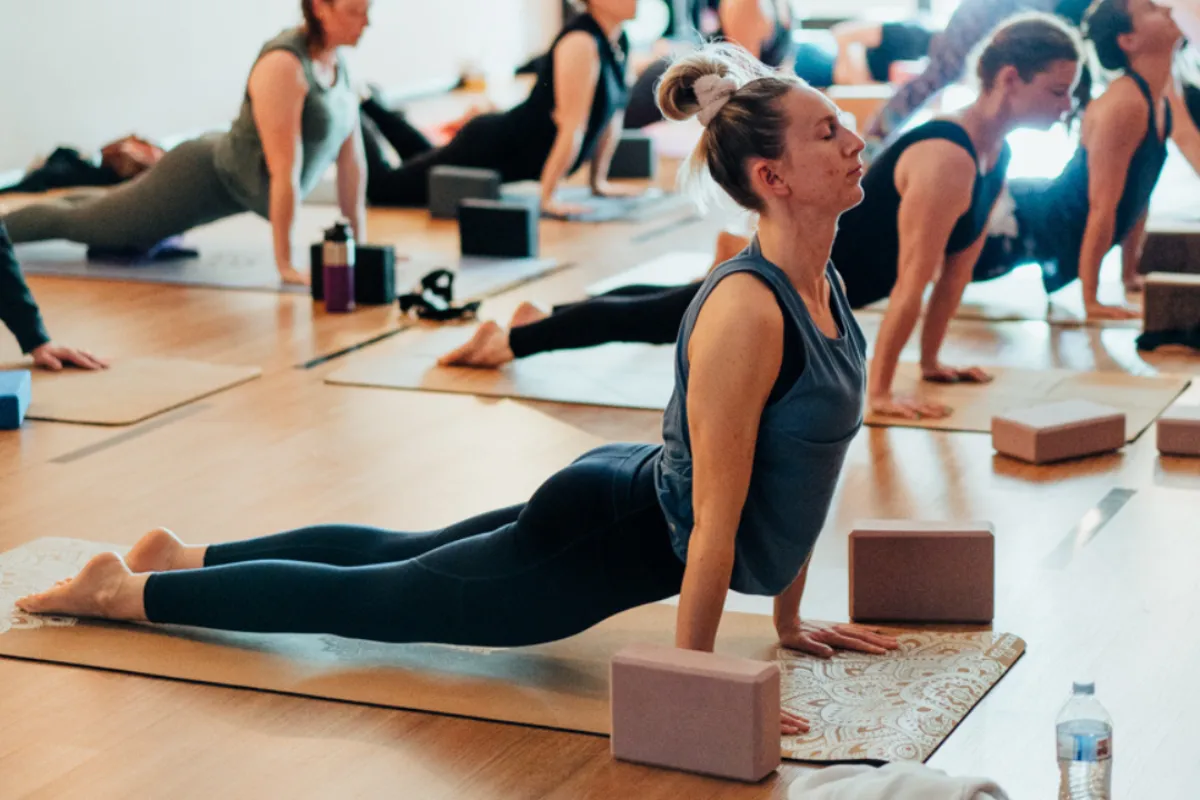
Cobra Pose Benefits: Why This Simple Backbend Is One of the Best Things You Can Do for Your Posture
Had a guy in class last week, first time on a mat in maybe ten years, get to Cobra Pose and just stop. Hands under his shoulders, chest barely off the floor, and he says, loud enough for half the room to hear, "this is the most my back's moved in a decade."
He wasn't joking.
That's the thing about Cobra. It looks like nothing. Lie on your stomach, press up a bit, hold for a few breaths. People skim past it on the way to poses that look harder. But most adults spend fourteen, sixteen hours a day folded forward (desk, steering wheel, phone) and Cobra is one of the only moments in a day where the body gets asked to do the opposite. Open instead of close. Extend instead of round.
That's not a small thing. That's the whole point.
I watch people do this pose wrong constantly, and it's almost always the same mistake: they straighten their arms all the way and push up as high as they can. It looks like progress. It's actually the opposite of what the pose is for. Full straight arms take the work out of the back muscles entirely and dump it into the wrists and the lower back. You end up doing a pose that looks like Cobra and does almost nothing Cobra is supposed to do.
Here's what's actually meant to happen. You're lying face down, hands flat under your shoulders, fingers spread. Pull the elbows in toward your ribs before you lift anything. That's what switches the upper back on instead of letting your arms do all the lifting. Feet active, pressing down through the tops of them, and draw the pubic bone into the mat so the lower back doesn't take the load it shouldn't be taking.
Then lift. Keep a bend in the elbows the whole way. Shoulders pull down away from the ears, collar bones spread wide, and you look slightly forward rather than cranking your neck back to see the ceiling. Hold it three to five breaths. Come down slow.
Done like that, you're working the erector spinae and the muscles between your shoulder blades, the ones that chronic sitting switches off completely. You're opening the chest and the front of the shoulders, which for most people have been quietly tightening for years without anyone noticing. And you're decompressing the lower back instead of loading it, which only happens when the mechanics are right.
If your lower back complains the second you lift, you've probably skipped a step most people skip. Drop to your forearms instead, elbows under your shoulders, forearms flat on the mat. That's Sphinx. Same opening, same muscles working, a fraction of the load through the lumbar spine. I tell people this constantly and they still treat it like the lesser version, the one for people who can't do the real thing yet. It's not. Sphinx done properly, with the upper back actually switched on, is harder than a sloppy Cobra. Most people should start there and earn their way into the full pose.
The mistakes stack up the same way every time. Arms locked straight. Shoulders creeping up toward the ears the second things get hard. Neck cranking back instead of following the upper back's lead. Legs gone soft, which means the pelvis has nothing stable underneath it and the lower back picks up the slack. Every one of those is fixable the moment you know to look for it, which is most of what I do in class, honestly. Less about the pose, more about pointing out what your body's been doing without telling you.
If you want to actually understand the mechanics behind this and the other poses that build the foundation of a solid practice, Master 21 Poses walks through it properly, not just the shapes, but why they work the way they do.
Recent or acute disc issues in the lower back? Check with your physio before loading into backbends like this one. Past the first trimester of pregnancy, skip lying on your stomach altogether. And if your wrists complain, that's another reason Sphinx exists.
In a normal class you'll hit Cobra inside a Sun Salutation, usually moving too fast to actually feel anything. The version that changes your body is the held one — three to five breaths, twice through, enough time to notice what's actually happening instead of rushing to the next shape. It sits well after Cat-Cow, before Child's Pose. Two rounds done properly on your lounge room floor, most mornings, and you're working against the only pattern most bodies know anymore.
The guy from last week wasn't being dramatic. Ten years of a body that only knows how to fold forward will make sixty seconds of opening feel like something. That's not the pose being impressive. That's just how far the body's drifted.
Come try a class and see how far yours has drifted. First 30 days are unlimited — find a time that works.
