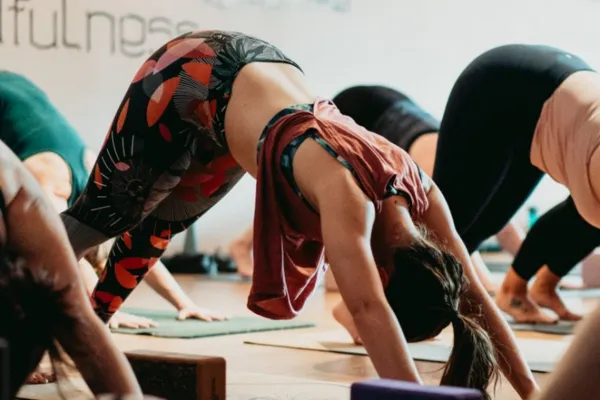
Downward Facing Dog: How to Do It Right and What It Actually Does For Your Body
Every yoga class has a pose that gets treated like a rest. A moment to reset between the things that actually matter.
Downward Facing Dog is that pose. And for most people, that's exactly the problem.
They drop into it, hang from the shoulders, let the upper back round, and wait for the teacher to cue the next thing. The wrists ache. The hamstrings pull. Nothing much happens. And they walk away thinking Downward Dog just isn't really for their body.
What they're describing isn't Downward Dog. It's a version of it that's missing most of what makes the pose worth doing.
Done properly, this is one of the most complete positions in yoga. The spine gets to decompress — genuinely lengthen — in a way that almost nothing else in daily life allows. The hamstrings and calves work through a sustained stretch. The shoulders build the kind of functional stability that carries over into posture and movement off the mat. The mild inversion shifts circulation and has a measurable calming effect on the nervous system. All of that from one shape, held for five breaths.
But only if the shape is actually right.
The thing most people miss is that Downward Dog is a pushing exercise. The hands are actively pressing the floor away. The hips are driving up and back. The chest is working toward the thighs, not sinking toward the floor. When that pressing action is present, the shoulder blades spread, the spine lengthens, and the pose does what it's supposed to do. When it's absent, the weight dumps into the wrists, the upper back rounds, and the whole thing becomes the uncomfortable non-event most people experience.
Start on all fours, hands under shoulders, knees under hips. Spread the fingers wide and press through the base of each finger and the heel of the hand. That full-palm contact is what keeps the wrists safe. Tuck the toes, lift the hips up and back, and immediately think about pushing the floor away rather than just holding a shape. Rotate the upper arms slightly outward. Let the shoulder blades spread. Drive the chest toward the thighs.
Now the legs. The heels don't need to reach the floor. Heel position is a byproduct of hamstring length and it can't be forced. Bent knees in Downward Dog are not a failure — they're often the smarter choice, because they allow the spine to lengthen properly without the lower back rounding to compensate. Prioritise the spine over the legs every time. The legs will open over months of honest practice. The spine needs to be right from day one.
Five slow breaths. Each exhale is a chance to let the spine decompress a little further.
If your wrists are sensitive, move to Dolphin — forearms on the floor, hips high — and get the same spinal benefit without any wrist load. If you want more challenge, lift one leg into Three-Legged Dog and notice what happens to the stability demand on the standing side. Keep the hips level. The moment they rotate open, you've lost the foundation.
People with wrist injuries or carpal tunnel should work with a teacher before loading this pose. Same goes for shoulder injuries where the rotator cuff is irritated. High blood pressure and late-stage pregnancy both warrant modification or avoidance.
Downward Dog is in almost every yoga class ever taught. Not because it's easy or because it's a good rest position. Because when it's done with real attention it does an enormous amount of work in a short amount of time. The people who get the most from it are the ones who stopped treating it as a pause and started treating it as a pose.
Long spine. Active hands. Five real breaths. That's the whole thing.
Come to class and let a teacher watch you in it — alignment feedback in this pose changes things faster than weeks of solo practice. Check the timetable this week, or start the OBH 30-Day Unlimited Trial and build the foundation properly.
