How Stress Changes the Way You Breathe — And Why That Makes Everything Worse
I had a student tell me she'd been feeling "wired but useless" for months. Sharp enough to feel tense all day, too foggy to actually get anything done. She'd tried more coffee, then less coffee, then a different multivitamin. None of it touched the actual problem, because none of it had anything to do with how she was breathing.
Most people don't notice their breath at all. It's automatic, background, handled without input. But under sustained pressure, a heavy workload, money stress, a hard season at home, that pattern shifts in a way that quietly makes everything else worse.
Shallow breathing and stress aren't two separate problems sitting side by side. They feed each other. And understanding that loop is one of the most practical things you can actually do about how you feel day to day.
Here's the mechanism. When your nervous system perceives a threat, real or otherwise, it triggers the stress response. Heart rate climbs. Muscles tighten. Breathing shifts from deep and diaphragmatic to shallow and chest-based. In a genuine emergency that's exactly the right response, priming you to move fast and react. The problem is modern stress rarely has a clean end point. The work pressure doesn't resolve when you leave the office. The money worry doesn't switch off when you walk through your front door. So the stress response just keeps running, and the shallow breathing pattern stays in place long after whatever triggered it has passed.
Eventually chest breathing becomes the default setting. Most people under chronic stress are breathing with only the top third of their lung capacity, and the diaphragm, the muscle actually built to do the heavy lifting, barely gets involved. That matters because diaphragmatic breathing is the signal that tells your nervous system it's safe to stand down. Without it, the system never quite gets the message.
The downstream effects go well past just feeling stressed. Under-breathing reduces oxygen delivery to the brain, and focus, clarity, and decision-making all take a hit as a result. Energy dips for no obvious reason, not because of poor sleep or bad food, but because your cells are getting less oxygen than they need. And the body stays in a low-grade state of alertness, not full fight-or-flight, but enough to leave you reactive and unable to properly switch off. That wired-but-foggy feeling, sharp enough to feel tense, too tired to concentrate, is usually this loop running in the background.
The frustrating part is that because the breathing itself is invisible, people chase the symptoms instead. More coffee for the energy dip. Trying to think their way out of being irritable. Wondering why focus won't come, without ever touching the simplest lever sitting right there.
Interrupting it doesn't require anything dramatic, but it does require consistency. One deep breath doesn't undo months of shallow breathing. A regular practice does.
Start by noticing. A few times a day, before a meeting, after an hour at the desk, check in. Is the chest rising while the belly stays still? That's your cue that you're chest-breathing. From there, an extended exhale resets things fast, because the exhale is what activates the parasympathetic nervous system. In for four counts, out for six or eight. No quiet room required. Desk, car, the thirty seconds before a hard conversation, all of it works.
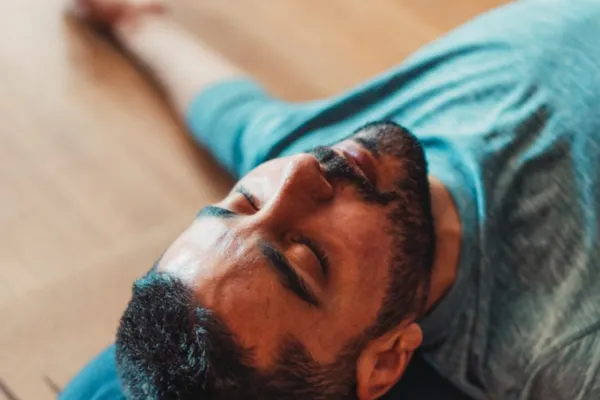
Daily diaphragmatic practice matters too. Lying down, one hand on the chest, one on the belly, breathing so the belly hand rises while the chest hand stays relatively still. Five minutes a day and the default pattern starts shifting within weeks. Linking breath to transitions helps as well, three full breaths every time you close a tab, leave a meeting, stand up from the desk. Small, but it interrupts the slow accumulation of tension through the day.
Yoga does something here that's hard to replicate on your own, because it integrates breath with movement directly. If you've ever noticed yourself holding your breath in a hard pose, in a tense conversation, while concentrating hard on something, that's a learned pattern, and a consistent practice is what retrains it.
If you want something to do right now, sit upright, close the mouth, breathe in through the nose for four counts letting the belly expand first, hold for one, exhale through the nose or slightly parted lips for six counts. Five rounds. Notice what happens in the shoulders, the jaw, the space between the eyes. That's the nervous system finally getting the signal it's been waiting for.
You breathe thousands of times a day, almost all of it on autopilot. A small fraction of those breaths, done well and consistently, changes more than people expect.
If you want this built into a proper daily habit, the Breathwork for Everyday Life course gives you the structure. Or come build it through movement — check the timetable and start with a class that integrates breath properly from the first minute.
