Knee Pain and Yoga: What's Actually Causing It and How to Move Safely
I had a guy come in a few months ago. Big bloke, used to play rugby, hadn't done much movement in years. He told me his knees were shot and he'd basically written off any kind of exercise that involved bending them. Stairs were a problem. Getting off the floor was a problem. He'd decided, at 47, that his knees were just part of who he was now.
We got him moving. Carefully, with modifications, nothing heroic. Six weeks later he told me the stairs didn't bother him anymore.
That's not a miracle. That's what happens when you stop protecting a joint from the one thing it actually needs.
The knee is a hinge joint. It flexes, it extends, it tolerates a small amount of rotation, and it does all of that well when the structures above and below it are doing their jobs. When they're not, the knee starts absorbing forces it was never designed to handle, and you feel it.
The most common driver I see is weak quads and glutes. The knee sits between the hip and the ankle, and it depends heavily on the muscles above it to share the load. When those muscles are underactive, which they will be if you're sitting most of the day, the knee takes on everything alone. That's where the ache at the front of the knee usually comes from, particularly on stairs or after long periods sitting.
The second thing is kneecap tracking. The kneecap is supposed to travel in a straight line as the knee bends and straightens. When the outer thigh is tight and the inner quad is weak, a very common imbalance in people who don't move much, the kneecap pulls slightly outward and creates friction. That's the grinding or clicking a lot of people notice and then quietly panic about.
Tight calves and hamstrings are in the mix too, putting the knee under sustained compressive load from below and above so the joint works harder than it should through movements that ought to be effortless. And then there's the load pattern itself. A sudden jump in activity after a sedentary stretch, long days on your feet, a lot of stairs — the knee can handle most of this, just not without adequate recovery. When demand outpaces recovery long enough, it signals.
If the knee is swollen, warm to touch, or significantly more painful than its usual baseline, back off. That's an acute phase and it needs a couple of days before you load it again. What you don't want to do is rest it completely and call that a solution. I see this constantly. People rest the knee for a week, it feels better, they go back to normal, and three weeks later the same thing happens again. Nothing changed, because the underlying drivers, the weak quads, the tight hamstrings, the poor mechanics, were never actually addressed. If something causes sharp pain inside the joint during movement, that's different from general muscle fatigue while rebuilding strength, and it's worth stopping for.
The principle from here is fairly simple. Strengthen what's above the knee and below it, restore its range of motion, and improve how you move through everyday activities. Wall sits, partial squats that don't go into a deep bend, and Bridge Pose all load the supporting muscles without grinding the joint, and three sessions a week of this, consistently, makes a measurable difference within four to six weeks. Calf and hamstring length matters more than most people realise too. A tight calf alone can drive significant knee load from below, and sustained holds through the posterior chain, thirty to sixty seconds, not quick bounces, reduce that tension over time.
Worth looking at as well is how you descend stairs and lower into chairs. Most knee pain isn't caused by anything unusual. It's aggravated by ordinary movements done with poor mechanics fifty times a day. Tracking the knee over the second toe rather than letting it cave inward, lowering into a chair with control rather than dropping, are small adjustments that add up to a genuinely different load pattern across a week.
Yoga brings a lot of this together. Bridge, a shallower Warrior II, Downward Dog, and seated forward folds all build the supporting structures while keeping the joint in a safe position.
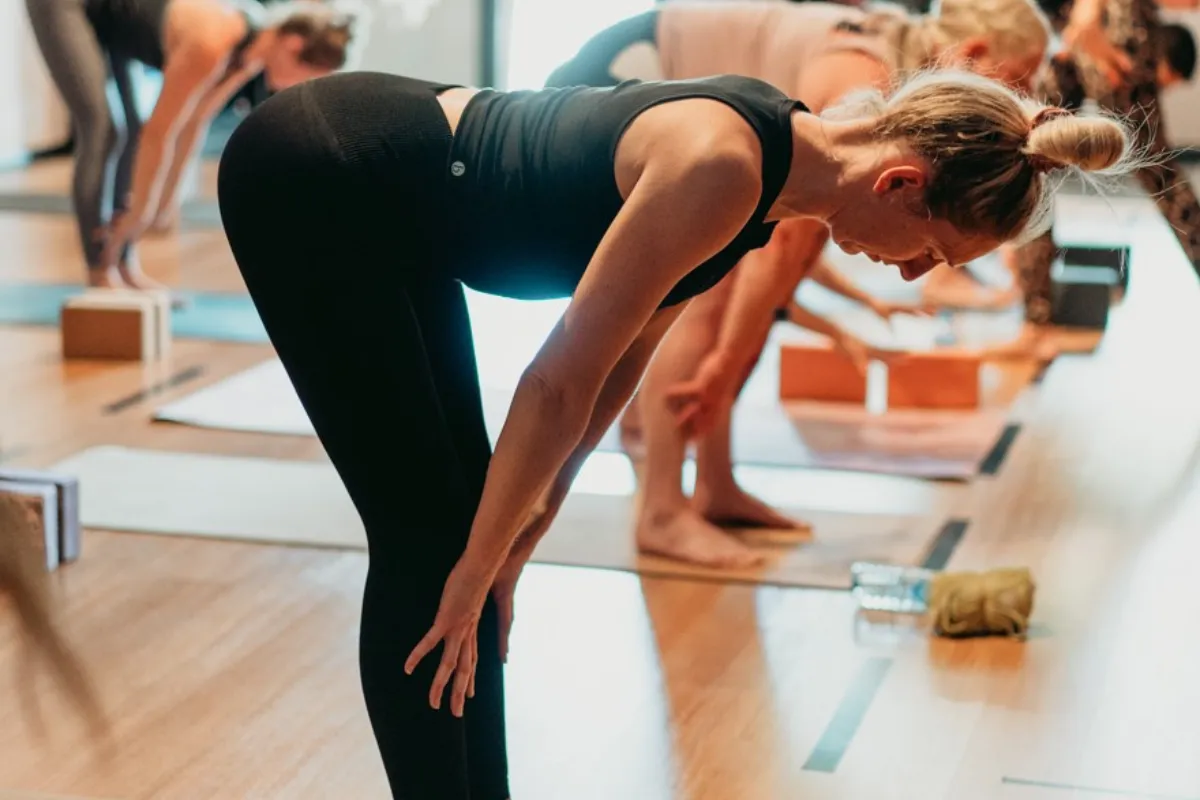
If you're coming to class with knee pain, the single most useful thing you can do is tell the teacher before you start. A good teacher will give you specific options, padding under the knee, a block to reduce depth, cues for tracking in standing poses, that make the session safer and more effective for where you actually are. You're not the only person in the room managing something.
If the knee is swollen and warm, locking, giving way, or painful enough to change how you walk, see a physio or GP before starting anything new. For the dull, recurring, stiffness-driven kind of knee pain most adults between 35 and 60 know well, the approach above applies, and you don't need a diagnosis to start moving better.
The guy with the rugby knees has been training with us for four months now. He doesn't talk about his knees anymore. Not because they magically fixed themselves. Because the muscles that were supposed to be doing the work are finally doing it.
Check the timetable and book a session this week.
