Tight Hips: Why They Ache, What's Actually Causing It, and How to Start Releasing Them
I had a student a while back who'd been doing the same hip flexor stretch every single morning for over a year. Faithfully. Diligently. And her hips were just as tight as the day she started.
She wasn't doing anything wrong, exactly. She just believed what most people believe — that tight hips are a flexibility problem, something you either have or don't, and the fix is more stretching. So she stretched, felt marginally better for an hour, and went right back to wondering why nothing actually changed.
Tight hips are rarely a flexibility issue. They're a movement issue. And until that distinction lands, stretching alone is never going to fix it.
Your hip is a ball-and-socket joint, built to move in pretty much every direction. Forward, back, sideways, rotation. When people talk about tight hips, what they usually mean is that the muscles around that joint have become shortened, overworked, or simply underused to the point where they're restricting movement and generating discomfort. The hip flexors at the front are the usual suspects, mostly because they're in a shortened position every time you sit, which for most adults is most of the day. But the glutes, the piriformis, the inner thighs, and the deep rotators are all part of the picture too. When any combination of those is restricted, the effects travel. Tight hips show up as lower back pain, knee discomfort, posture issues — because when the hip can't do its job, something nearby has to compensate.
Sitting is the obvious driver. Car, desk, dinner table, couch — the modern adult spends most of their waking hours with hips locked in a flexed position, and the muscles adapt to that over time by shortening. But it's not only sedentary behaviour. Running the same route every day without any variation can create a near-identical problem from the opposite direction, where the muscles are working constantly but only through a narrow range, and they tighten within it.
The one most people don't expect is stress. The hip flexors and the muscles around the pelvis are closely tied to the body's stress response, and chronic tension from sustained pressure tends to settle in this exact area. A lot of people only discover how much they're carrying there once they actually start doing consistent mobility work and feel what comes up.
The instinct when hips feel tight is to stretch hard and stretch cold. That's usually the wrong move. Pulling into a deep stretch before the body is warm doesn't release tension, it triggers a protective reflex that tightens things further. Equally unhelpful is sitting even more to "rest" them, which almost never solves a problem that sitting caused in the first place. And if you feel a pinching sensation right at the front of the joint rather than a deep stretch sensation, that's worth backing off from and getting checked, not pushing through.
What actually works is less dramatic than people expect. Warming up first, even just five to ten minutes of walking or some slow cat-cow, changes how the muscles respond enormously. Warm tissue releases. Cold tissue braces. From there, working in every direction rather than defaulting to the same front-of-hip stretch matters, because tightness is rarely one-dimensional. Active movement through the range, rather than just dropping into a passive hold and waiting, builds both mobility and strength at the same time, which is what creates change that actually lasts rather than fading by the next morning.
And consistency beats intensity, every time. Ten minutes a day, five days a week, will outperform one heroic hour-long stretch session done once a fortnight. The body responds to frequency far more than force.
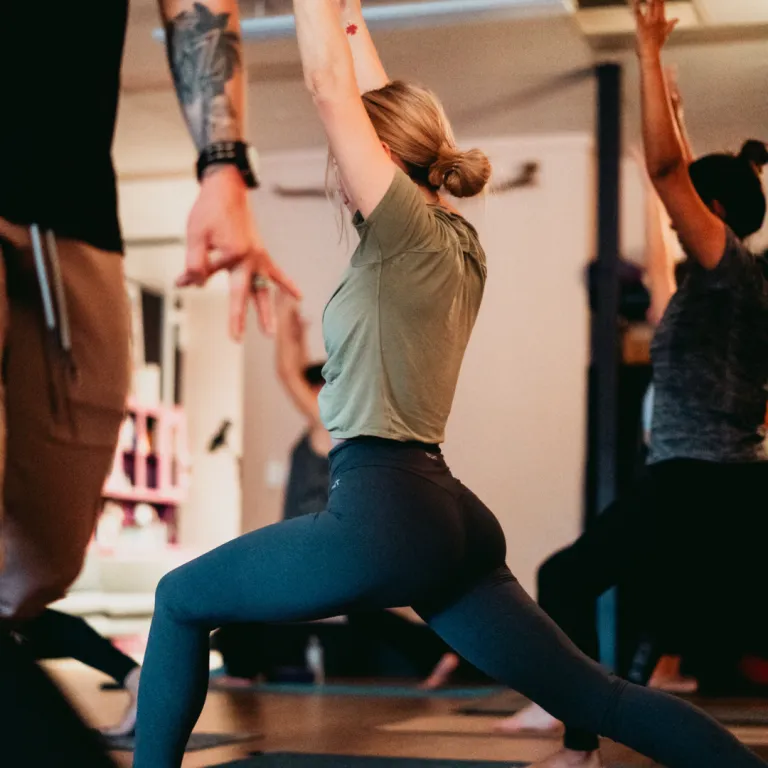
A well-structured class does a lot of this work for you, because it moves the hips through multiple planes in a single session, which almost nobody does on their own. The other advantage of a class is having someone watch your alignment. Hip tightness often comes with compensations — hiking a hip, rotating the pelvis, collapsing into the lower back — that you genuinely cannot see yourself, and those compensations are usually the real reason the tightness keeps returning no matter how much you stretch.
If pain radiates down the leg, or you're getting numbness, sharp pinching, or pain that lingers well after rest, that's worth a proper assessment before you keep moving through it. Ordinary stiffness that eases once you get going is a different story, and it tends to respond well to consistent movement.
Tight hips don't need to be attacked. They need attention, applied regularly, in every direction the joint is meant to move. That's the whole strategy, and it's a lot less complicated than the year of solo stretching most people put themselves through first.
Check the timetable and find a session this week, or start the OBH 30-Day Unlimited Trial and let the cumulative effect of consistent classes do what stretching alone never could.
