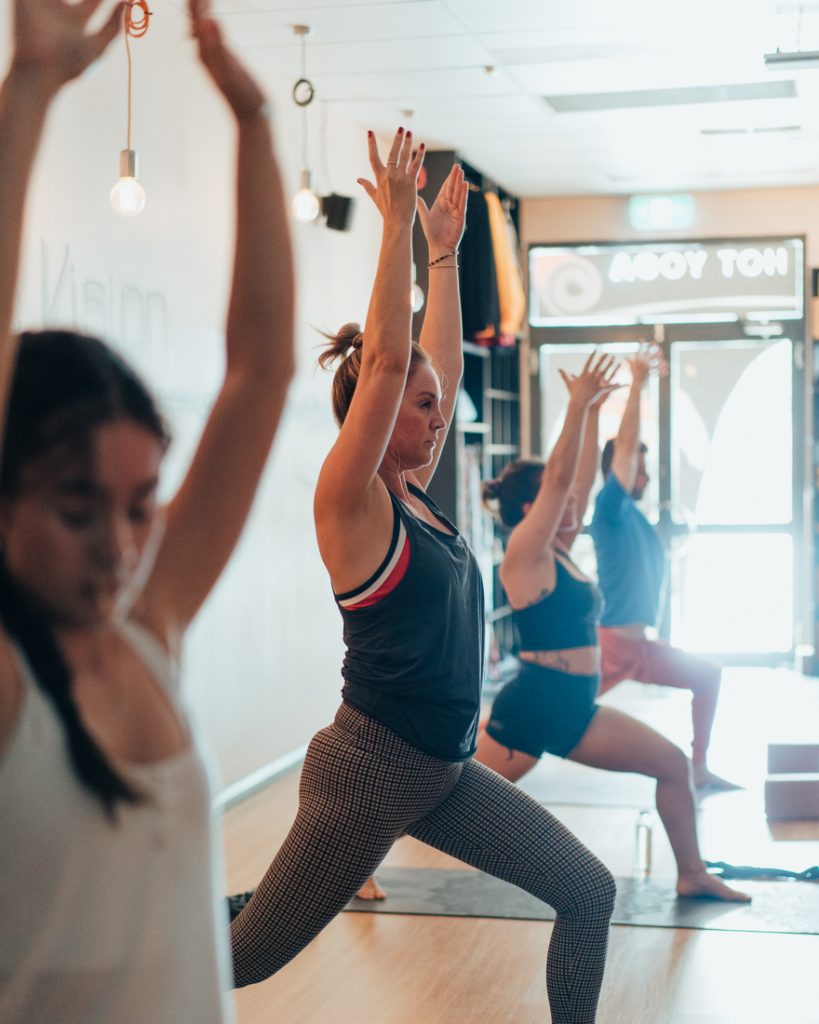
Warrior I Pose: The Back Foot Fix That Changes Everything
About a third of the class can't figure out why their front hip keeps driving forward in Warrior I. They're doing everything right from the waist up: arms lifted, chest open, front knee over the ankle. The problem's in the back foot. It almost always is.
Warrior I gets treated like a shorter version of Warrior II. Same pose family, similar shape on the mat. The difference is the back foot. In Warrior II, the back foot is parallel to the top of the mat, back hip open to the side wall — and that's correct. In Warrior I, the back foot turns in, and with it, the back hip needs to drive forward toward the front of the room. That internal rotation is the whole pose. Most people skip it.
When the back foot stays too parallel, the back hip stays open. The pelvis can't square forward. And instead of the glutes and the back leg doing the work Warrior I asks for, the front hip takes the load, the lower back compresses, and the arms are just doing their best up top.
Setting Up Warrior I Pose
From Mountain Pose, step one foot back about a metre.
Turn the back foot in to 45–60 degrees. Not parallel to the front of the mat, not perpendicular. The outer edge presses into the mat and the heel stays grounded.
Draw the back hip forward toward the front of the room. This is the step most people miss. The hip needs to actively move.
Bend the front knee to stack over the second toe, not caving inward.
Inhale and sweep both arms up, shoulder blades drawing down as the arms rise.
Hold for five slow breaths before switching sides.
The biggest mistake I see is the back heel lifting. When the heel comes up, the back leg switches off. The calf takes the load, the ankle works overtime, and the back hip has nothing stable to drive from. If the heel is lifting, widen the stance until it can stay down. That matters more than the depth of the front knee bend.
The second one is the back foot rotating too far past 45 degrees toward 90, which compresses the ankle and closes the hip differently. The sweet spot is 45 to 60 degrees for most people, and it shifts depending on hip and ankle mobility. There's no single right number.
For tighter hips or ankles, a wider stance gives the back foot room to sit without forcing the angle. Some students respond better to just the hip cue alone — draw the back hip forward — and let the foot follow naturally rather than trying to hit a specific degree of rotation. The hip moving forward is the goal. The foot position is just the mechanism that makes it possible.
If you've had a knee reconstruction or hip replacement, get a teacher's eye on this before going deep into the front knee bend. And if the back ankle feels compressed at any angle, that's worth addressing separately before working the pose fully.
Warrior I fits well mid-sequence after the hips have been warm: following Sun Salutations, after lunges, before Triangle or Revolved poses. It's a preparation pose as much as it is a destination.
When the back foot finds its angle and the back hip drives forward, the pose gets harder and more satisfying at the same time. The work in the back leg is the pose doing what it's built to do. Most people have never felt that because the back foot was never right.
If you want to work through this with video instruction and full cueing, Warrior I is covered in Master 21 Poses alongside the other foundational shapes that make everything else in class make more sense.
Get on the mat this week and feel the difference when the back hip actually moves. Check the timetable and find a class that works for you.
