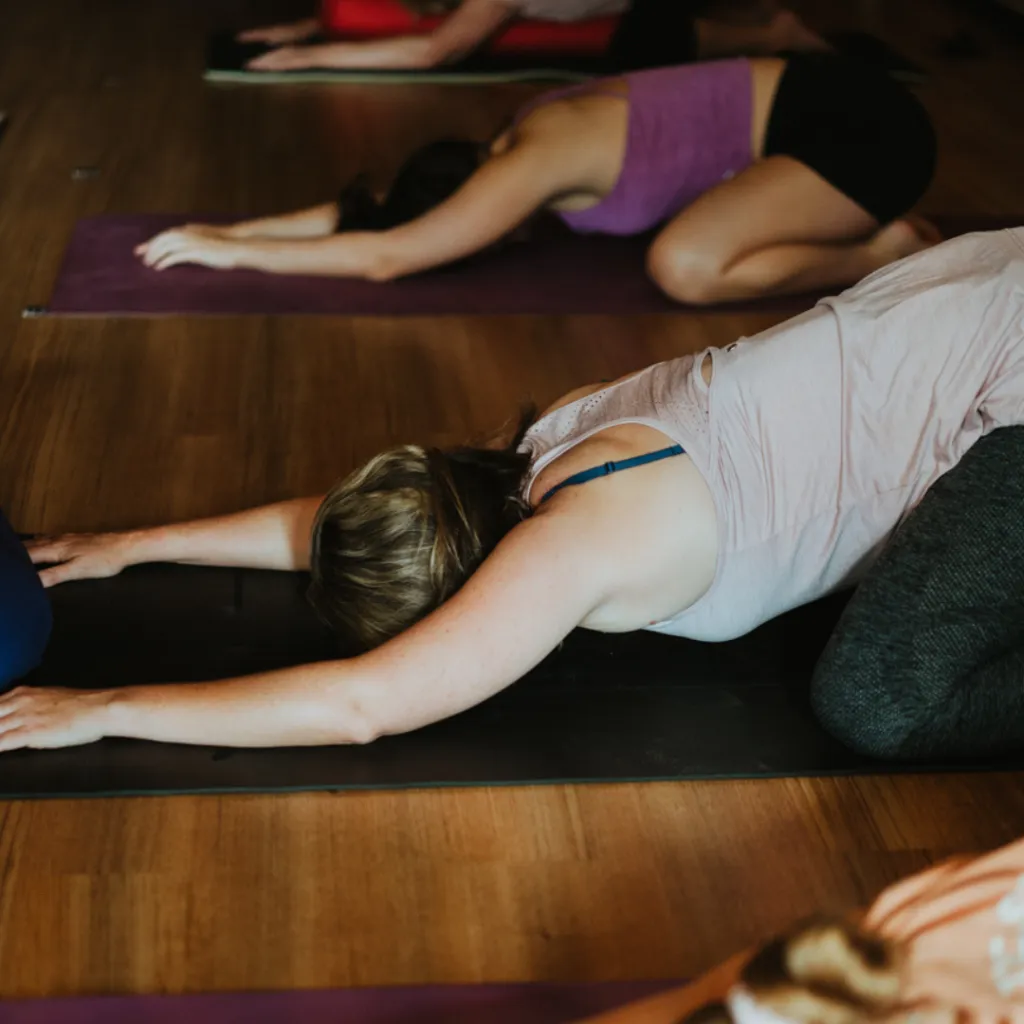
Puppy Pose (Anahatasana): Open Your Heart and Release Tension
There's a moment that happens in Puppy Pose, usually around the third or fourth breath, where I watch people's shoulders drop somewhere they didn't know they'd been holding them.
It's not dramatic. There's no big release, no audible exhale. Just a slight settling, like the body's been waiting for permission and finally got it.
That's the thing about this pose. It doesn't ask for much physically, but it asks for something most adults aren't great at offering — actual softening, in the front of the body, while staying completely supported. No effort to push through, nothing to prove. Just the chest melting toward the ground while the hips stay anchored.
Anahatasana, the Sanskrit name, comes from "anahata," meaning unstruck. It's the same word used for the heart centre. Whatever you make of that philosophically, the physical version of "unstruck" is straightforward enough: a heart that hasn't been guarded, braced, or pulled tight by months of hunching over a desk.
And that's exactly what most people walk in carrying. Hours rounded forward over a keyboard shortens the chest and pulls the shoulder blades wide apart, and the upper back compensates by gripping. Puppy Pose works directly against that pattern. The hips stay stacked over the knees, almost identical to Child's Pose, but the arms reach forward and the chest sinks toward the floor, creating the kind of opening across the front body that desk life slowly closes off.
What's actually happening underneath the shape: the spine lengthens from tailbone through fingertips without compressing the lower back, because the hips are doing the grounding work while the upper body does the opening. The shoulders and upper traps, usually the first place people carry tension, finally get a genuine stretch rather than another round of rolling or rubbing. And because the position is passive enough that nothing's straining to hold it, the nervous system tends to settle here in a way it doesn't in more active poses.
To get into it, start in tabletop, hands and knees, and walk your hands forward while keeping your hips exactly where they are, stacked above the knees. Lower your forehead or chin toward the mat and let your chest drop, arms staying active, palms pressing down, fingers spread. Five to ten breaths, and with each exhale, see if there's a little more give than the breath before.
If the shoulders are tight, rest the forehead on a block or a stack of fists rather than forcing the reach. If the neck doesn't love chin-down, forehead is always the better option. A bolster under the chest works well too if you want more support and less demand.
This is a pose I'll often bring in after a long day of desk-hunching, or as a bridge between something active and something restorative, or right before deeper backbends like Camel or Wheel, because it opens exactly what those poses need open. It's also one I'll suggest on the harder emotional days, the ones where staying guarded feels safer than softening. Not because the pose fixes anything on its own, but because it offers a few quiet breaths of practice at doing the opposite.
Strength doesn't always look like effort. Sometimes it looks like letting the chest drop toward the floor and trusting that nothing bad happens when you do.
Check the timetable and come find a class that includes this kind of work, or explore the Master 21 Foundation Poses course if you want to understand how poses like this one connect to everything else in your practice.
