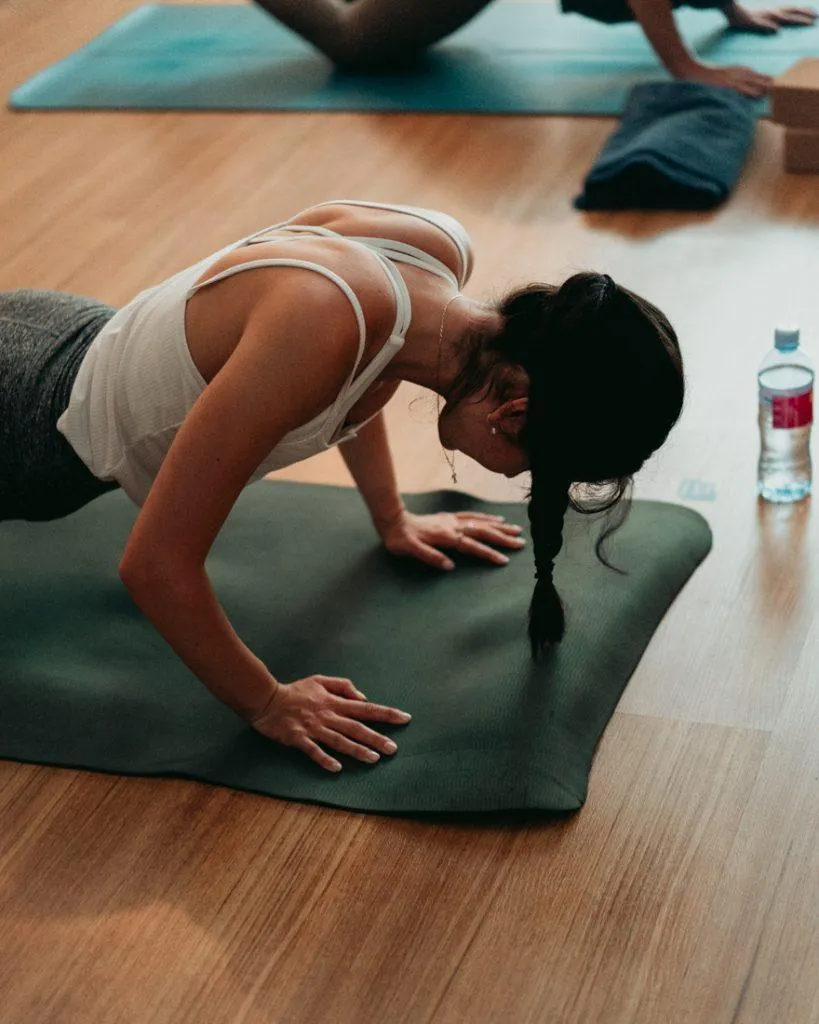
Stacked Plank Pose: Building Strength Through Precision
Stacked Plank Pose is a powerful progression from traditional Plank that challenges your strength, stability, and alignment in a deeper and more refined way. By stacking one foot directly on top of the other, the base of support becomes narrower, forcing the core, shoulders, and legs to work harder to stabilise the body. This pose teaches you how to generate strength through precision rather than momentum, making it an essential posture for developing total-body control.
At its core, Stacked Plank Pose is about integration. The arms press firmly into the ground, the core draws inward to protect the spine, and the legs remain active to maintain balance. Every muscle contributes to holding a straight, stable line from head to heels. This unified effort builds not just physical strength, but also mental focus and endurance.
The Power of a Narrow Foundation
When both feet are on the floor in a standard plank, the body has a wide, stable base. Stacking the feet removes that stability and forces the deep core muscles—including the transverse abdominis and obliques—to activate more intensely. The shoulders and glutes also engage more deeply, helping protect the joints while building resilience.
This increased demand makes Stacked Plank Pose a highly effective tool for improving functional strength, especially for movements that require balance and coordination.
Benefits of Stacked Plank Pose
Builds Deep Core Strength
Stacking the feet significantly increases the demand on the core muscles, helping strengthen the entire abdominal wall and improve spinal stability.
Strengthens Shoulders and Arms
Supporting your body weight through the arms builds endurance and resilience in the shoulders, wrists, and triceps.
Improves Balance and Stability
The reduced base of support challenges proprioception, teaching the body to stabilise itself more efficiently.
Enhances Postural Alignment
Practising this pose reinforces the habit of maintaining a neutral spine and strong, aligned posture.
Develops Mental Focus and Control
Holding the position requires calm, steady breathing and concentration, strengthening the mind as well as the body.
How to Practise Stacked Plank Pose
Begin in a standard Plank Pose with your hands directly under your shoulders and your body forming a straight line.
Press firmly through your palms and engage your core by drawing your navel gently toward your spine.
Bring your feet together, then slowly stack one foot directly on top of the other.
Keep your legs active and your glutes engaged to stabilise the pelvis.
Maintain a long spine, keeping the neck neutral and gaze slightly forward.
Breathe steadily and hold the pose for 20–40 seconds.
To release, separate the feet and lower the knees to the ground with control.
Modifications and Tips
If stacking the feet feels too unstable, keep the feet together without stacking them.
Practice near a wall for additional balance support if needed.
Focus on pressing the floor away to activate the shoulders fully.
Avoid letting the hips sag or lift too high—aim to keep a straight, strong line.
If wrist discomfort occurs, try practising on your forearms instead.
When to Use Stacked Plank Pose
Stacked Plank Pose works well in strength-focused yoga sequences, core conditioning routines, or as preparation for arm balances such as Side Plank and Handstand. It is especially useful for athletes and practitioners looking to build greater stability, coordination, and structural strength.
Conclusion
Stacked Plank Pose proves that small changes can create powerful results. By narrowing your foundation, you force your body to organise itself more efficiently, building strength, stability, and awareness. With consistent practice, this pose will improve not only your yoga performance but also your overall movement quality, posture, and confidence.
