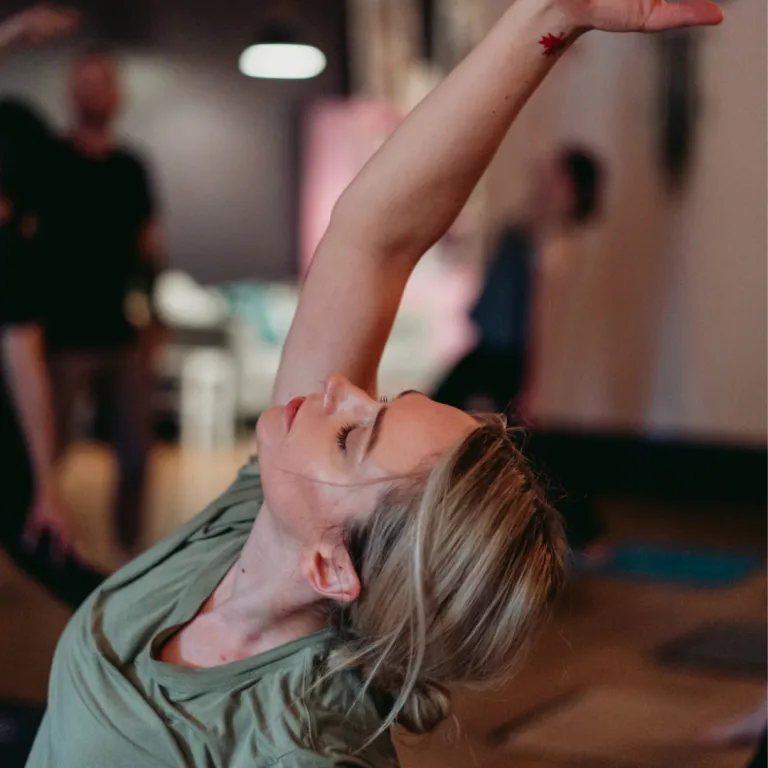
Warrior II with Reverse Twist: Build Strength and Balance from the Inside Out
There's a moment in Warrior II that most people rush past.
The legs are working, the arms are extended, the pose looks right from the outside. But inside, nothing much is happening. The front thigh isn't loaded properly. The back foot is passive. The breath is shallow. The mind has already moved on to the next pose.
Warrior II is one of those postures that reveals exactly how present you are. And when you add a twist to it, there's nowhere left to hide.
The combination of Warrior II with a reverse twist isn't a variation for its own sake. It takes everything the standing pose is already asking of you — stability, load, breath, focus — and adds a rotational demand that exposes every weak link in the chain. The hips have to stay grounded while the spine unwinds above them. The legs have to keep working while the upper body opens. The breath has to stay steady through all of it.
That's a significant ask. Which is exactly why it's worth doing.
To get into it, start in Warrior II with your right foot forward. Front knee stacked over the ankle, back heel pressing into the floor, arms reaching shoulder height. Take a breath here and actually load the pose before you move. Feel the front thigh working, the back glute engaged, the spine long.
On an exhale, bring your left elbow to the outside of the front knee. Hands can come to prayer position for leverage. Now begin the twist — and this is the part people get wrong — start from the belly. Let the rotation begin deep in the abdomen, move through the ribs, and arrive last in the shoulders. If you lead with the arm or the shoulder, you get a shoulder stretch. If you lead from the core, you get a spinal twist.
Keep both feet grounded throughout. The moment the back heel lifts or the front knee drifts in, the foundation is gone and the twist becomes a compensation rather than a rotation. If you can't breathe steadily in the full expression of this, back off the depth. Ease is not the same as going easy. It means you've found the version your body can actually work in.
Hold for three to five slow breaths. On each exhale, see if the twist deepens slightly without you forcing it. Then release back to Warrior II and feel what's changed.
The mistakes here are predictable. Forcing the twist through the arm rather than rotating from the core is the most common. The elbow becomes a lever and the lower back takes the strain. The fix is to think less about how far you're rotating and more about where the rotation is initiating. The second mistake is losing the legs entirely. People get absorbed in the upper body and the lower body goes passive. The front thigh should still be working. The back heel should still be pressing. The pose is the whole thing, not just the twist on top.
If the elbow to knee is too much, place the bottom hand on a block at the inside or outside of the front foot and work on the rotation from there. If the hips are tight and the pelvis is tilting, drop the back knee to the floor and do the twist from a low lunge position. Both versions give you the rotational benefit without asking the body to do more than it currently can.
People with acute lower back issues or disc problems should approach twisting with caution and work at minimal depth until things have settled. If the twist creates sharp pain rather than muscular sensation, come out and reassess.
What this pose builds over time is worth understanding. The lower body strength is obvious. But the deeper adaptation is the coordination between stability and mobility — the ability to keep one part of the body grounded and working while another part moves freely through its range. That's a quality that transfers directly into how you move in daily life, how your body handles load and rotation, and how present you can stay when something is genuinely demanding.
Most yoga builds that quality slowly, quietly, in the background. Warrior II with a twist puts it right in front of you.
Check the timetable and come and work through this in class, or explore the Master 21 Foundation Poses course if you want a structured breakdown of the key standing postures and what they're actually building in your body.
